
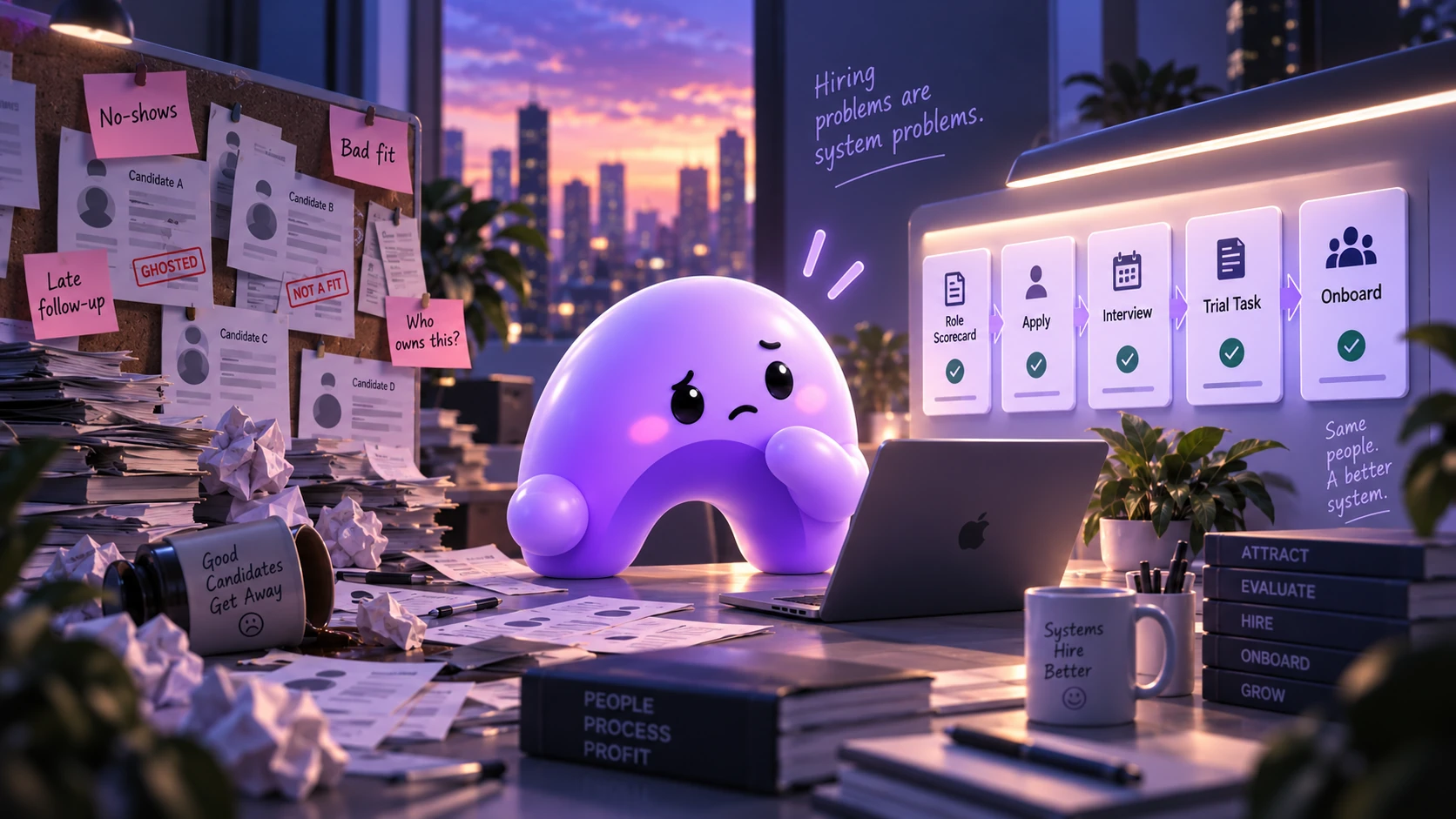
Hiring breaks at $100K a month. Almost every time. And most owners think it's a people problem. They blame the hires. They blame the market. They blame the recruiters. They blame the compensation.
It's not a people problem. It's a systems problem.
Here's what happens. You're doing $50K, $80K, $100K a month and you need help. So you hire someone. A setter, a closer, an assistant, a fulfillment person, whatever it is. And they come in and they're lost. There's no onboarding. No training documentation. No process for them to follow. No clear expectations. No ramp-up timeline. So what happens? You train them yourself. Personally. You sit with them, walk them through how you do things, answer their questions, correct their mistakes, and hope they absorb it.
Two things happen from there. Either they figure it out slowly through trial and error while costing you leads, clients, and momentum. Or they don't figure it out, they quit or get fired, and you start over from zero.
Either way, you lost time. You lost money. And you're still the one training the next person.
The reason this keeps happening isn't that you keep hiring bad people. It's that you have no system for turning a new hire into a productive team member. The business has no documented process. No training materials. No onboarding sequence. No structure that says, here's what you learn in week one, here's what you do in week two, here's how we measure if you're on track.
So every new hire starts at zero and stays there longer than they should. And every time you hire someone, you personally go back to zero too. Because you're the training system.
That's why hiring keeps breaking. Not because the people are bad. Because there's no system to plug them into.
Here's what the fix looks like.
You build a hiring and onboarding system that does three things. First, it documents the role clearly. What this person does, what success looks like, what the expectations are from day one. Second, it creates a training path. Not you sitting next to them for two weeks. Actual materials, recorded trainings, written SOPs, a sequence they can follow to learn the role without you being in the room. Third, it creates a ramp-up timeline. Week one they learn X. Week two they do Y. Week three they're handling Z. And you can measure whether they're on track at each stage.
When that system exists, hiring stops being a gamble.
A new hire comes in, they follow the path, they get up to speed in a fraction of the time, and you're not personally involved in every step. If they don't work out, you know faster because the system shows you where they fell behind. And when you hire the next person, the system is already there. You don't start over.
The businesses that scale past that $100K ceiling don't have better hires. They have better systems for turning hires into productive team members. That's the difference.
This is one of the five things we install when we build out the Ariyel operating system. The hiring and onboarding system is part of it, because without it, every new hire is a tax on your time and a risk to your business.
But even if you never work with us, build this. Because every month you're personally training new hires is a month you're doing $20/hour work in a business that needs you doing $500/hour work.